Beyond Generative AI: The Strategic Shift to Agentic Commerce
By B. Ellie Jin
Most industry professionals are now familiar with Generative AI—the tools that write product descriptions or create marketing images. However, a significant shift is currently underway in the fashion world: the move from Generative AI to Agentic AI.
From Creative Freelancer to Digital Employee
So, what exactly is Agentic AI? Simply put, it is AI that works on your behalf. An AI agent doesn’t just suggest things; it possesses the autonomy to work without constant human intervention. It can reason through complex goals, use software tools like inventory or email systems, and even self-reflect to learn from its own mistakes.
To understand the difference between the two, think of it this way:
- Generative AI is like a navigation system. It gives directions, but you still have to drive. It waits for your prompt.
- Agentic AI is like a self-driving car. It acts as a “digital employee” that can navigate the road, use the controls, and reach the destination without constant supervision.
The Rise of Agentic Commerce
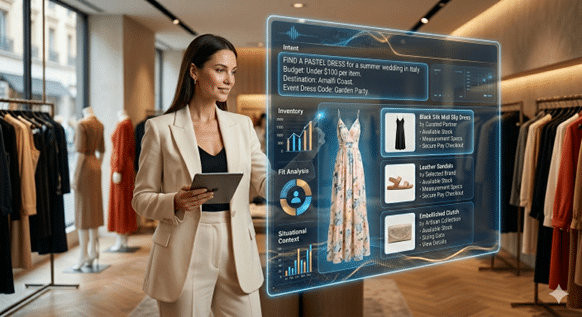
In the old “Click Era,” we searched for products using keywords and filters. In the Agentic Commerce era, we shop by “intent”. Instead of browsing for hours, you simply tell an AI: “Find me a pastel dress for a summer wedding in Italy for under $100.” For the past two years, tech giants like OpenAI, Amazon, and Google are already spearheading this movement, while a new wave of startups is following suit.
- Daydream: This platform analyzes your personal style, the weather at your destination, and even event dress codes to curate a complete outfit. Launched just last year in NYC, it already syncs nearly 2 million items from brands like Nike and Alo Yoga.
- Gap & Google Gemini: This is a game-changer. Gap provides real-time inventory and sizing data directly to Gemini. Customers can find and buy Gap products using Google Pay without ever leaving Gemini.
Is Your Brand Ready to Sell to an AI?
We are moving from a world where humans browse websites to a world where the AI is the customer. If shoppers can find exactly what they need across thousands of brands on a single AI platform, why would they ever visit an individual brand’s website again? This is the new survival challenge for fashion retailers.
Strategies for Large Fashion Enterprises
To remain competitive in the Intent Era, global retailers must re-engineer their digital presence for a world where AI agents lead discovery and transactions. Here are three key strategies to navigate this shift.
i) From Search to Curation: Traditional search bars are being replaced by “Brand Agents.” For example, Ralph Lauren’s “Ask Ralph” acts as a personal stylist. It moves beyond keyword matching to understand why you are shopping, providing a curated experience rather than a long list of links.
ii) From SEO to AEO (Answer Engine Optimization): It’s no longer enough to rank high on Google. You must optimize your data for AI engines. If an AI agent cannot “read” or understand your product, it will never recommend it. In this new era, your primary customer is the AI.
iii) Move Toward “Noun-Heavy” Clarity: Brands must move away from poetic names and embrace descriptive clarity.
- The Problem: “Midnight Muse Dress” (AI struggles to categorize this).
- The Solution: “Black Silk Midi Slip Dress” (An AI identifies this instantly). Metadata should also include situational context—like “garden wedding” or “summer gala”—so the agent knows exactly when to suggest your brand.
The Path Forward: Key Questions for Leadership
As this shift accelerates, fashion leaders must ask themselves three critical questions:
- Is our data machine-readable? If an AI agent can’t “read” your stock in real-time, it will simply recommend a competitor who is “Agent-Ready.”
- Who owns the customer relationship? If an AI handles the entire transaction, how do you keep a direct bond with the human shopper?
- What then remains as the irreplaceable core? If AI manages the mechanics of the sale, isn’t what’s left—and what must never be surrendered—the brand’s unique value, identity, and vision?
- Categories: